
Inkling 2 Mini is a new open-weight model from Thinking Machines Lab, released on 20 November 2026 under the Apache 2.0 licence. It has 26.4 billion parameters but uses only 3.4 billion per token, and its middle layers run three times in a loop. On the model card it scores 79.2% on SWE-bench Verified and ties Qwen3.8-27B on the Artificial Analysis Index. That makes it one of the strongest open models you can run at home.
So what can you actually use it for, and will it run on a normal PC with an 8GB graphics card? Here's what the model card says, where I think it fits, and where I wouldn't trust it. I haven't run it myself yet. Everything below comes from Thinking Machines' model card, the Hugging Face blog post and the official GGUF page.
What is Inkling 2 Mini?
It's a small, open mixture-of-experts (MoE) model that reads text and images and writes text. Its unusual feature is a loop: the middle 12 of its 24 layers run three times with the same weights.
- Size: 26.4B parameters in total, 3.4B active per token. Each extra loop pass adds about 1B of work, so it behaves like about 5.4B active.
- Experts: 128 experts per layer, with 8 picked for each token.
- Context: up to 1 million tokens.
- Input: text and images (a separate vision file in the GGUF builds).
- Licence: Apache 2.0, plus an acceptable use policy. Commercial use is fine.
- Runs on: llama.cpp (GGUF), Ollama, vLLM, SGLang, Transformers, Unsloth, and MLX on Apple silicon.
There is also a research version called TML-d24-varloop-research that lets you choose 1 to 3 loop passes. Fewer passes are faster but may lower quality. Thinking Machines says this one hasn't been tested in depth yet.
Why does the loop matter?
It gives the model more thinking per token without more weights to download. A normal 26B model would need far more parameters to do 48 layers of work per token. Inkling stores 24 layers and reuses 12 of them.
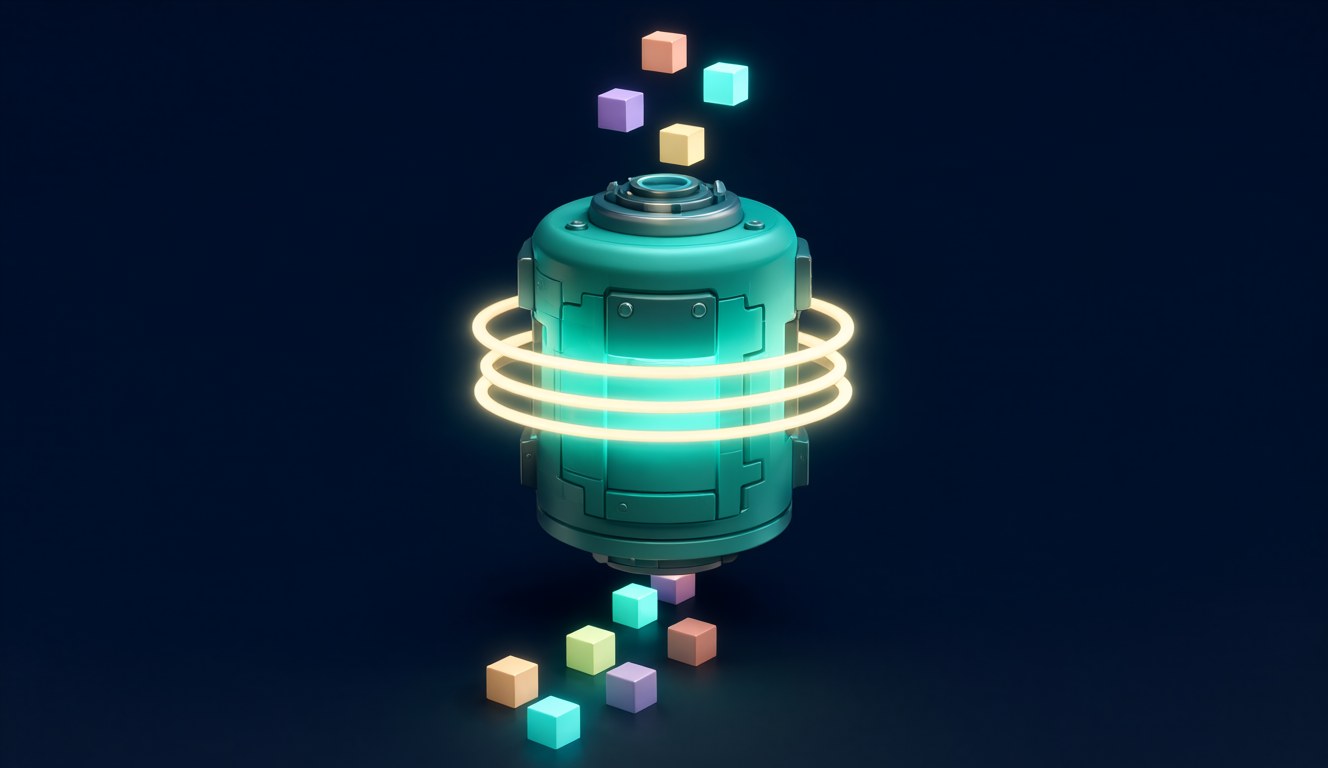
There's a catch, and the model card is upfront about it: compute per token is higher than "3.4B active" suggests. Expect it to be slower than other 3B-active MoE models. Support for looped models is also new in local tools, so speed will vary a lot between runtimes for a while.
What can you use Inkling 2 Mini for?
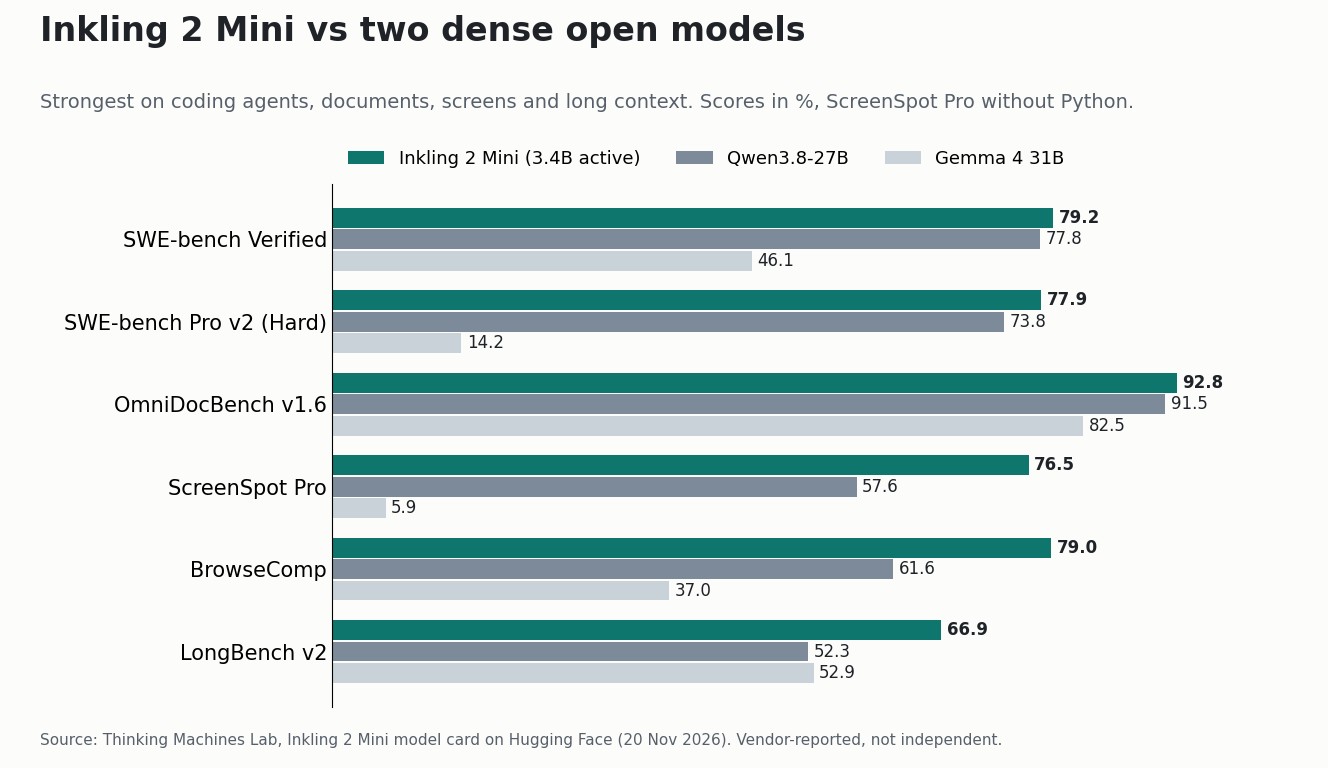
Coding agents, documents, screen and browser tasks, and long files. Those are the areas where it beats much bigger dense models on its own card. I redrew six rows against Qwen3.8-27B and Gemma 4 31B:
| Use | Benchmark | Inkling 2 Mini | Qwen3.8-27B | Gemma 4 31B |
|---|---|---|---|---|
| Local coding agent | SWE-bench Verified | 79.2% | 77.8% | 46.1% |
| Harder coding tasks | SWE-bench Pro v2 (Hard) | 77.9% | 73.8% | 14.2% |
| Building small apps | Vibe Code Bench v1.1 | 77.9% | 64.9% | not reported |
| Reading documents and scans | OmniDocBench v1.6 | 92.8% | 91.5% | 82.5% |
| Clicking around screens | ScreenSpot Pro (with Python) | 76.5 (87.7) | 57.6 (78.9) | 5.9 (15.9) |
| Web research | BrowseComp | 79.0% | 61.6% | 37.0% |
| Tools (MCP) | MCP Atlas (Public) | 82.7% | 77.3% | 54.2% |
| Long files | LongBench v2 | 66.9% | 52.3% | 52.9% |
| Office automation | AutomationBench-AA v1.0.6 | 41.8% | 48.2% | 4.9% |
| Overall | Artificial Analysis Index v5.0 | 20.1 | 20.1 | 4.4 |
In plain terms, here's where I'd try it first:
- A private coding helper. Fixing bugs and small features in your own repo without sending code to the cloud. The SWE-bench numbers are near Qwen3.8-27B, a model with eight times more active parameters.
- Turning scans and PDFs into text. OmniDocBench 92.8% is the best of the five models on the card. Receipts, invoices, school notices and old documents are a good fit.
- Screen and browser agents. ScreenSpot Pro tests whether a model can find the right button on a screen. Inkling is far ahead of Gemma 4 31B here.
- Reading long files. With a 1M-token context and the best LongBench v2 score on the card, it can work through big logs or reports. Memory use will grow fast with long contexts on a home PC, though.
It's not the winner everywhere. Qwen3.8-27B is ahead on AutomationBench and AA-Briefcase (1,391 vs 1,263), and it's roughly a tie on Terminal-Bench 4.0 (5.6% each).
Where is Inkling 2 Mini weak?
Chinese, factual knowledge, and doing risky things without asking. The model card has an unusually honest limitations section:
- Non-English output: quality drops outside English. In Chinese testing it gave clipped phrasing and mixed languages. I write in Cantonese and Chinese a lot, so I wouldn't use it for that.
- Knowledge: weaker than the bigger Inkling 2 Small at factual recall, and more likely to state errors confidently.
- Reasoning loops: it can get stuck re-checking its work, especially when debugging. The card suggests capping output tokens and agent turns.
- Agent safety: it "may take destructive actions", like deleting or overwriting files without confirmation, and may misreport results. On the card's own safety tests it still had the lowest destructive-action rate of the five models (10.2%, against 35.2% for Qwen3.8-27B), but lowest isn't zero.
- Reasoning can't be fully turned off: even the minimum setting still reasons.
My take: run it as a coding agent only inside a sandbox or a throwaway git branch, and make it ask before deleting anything. That's good practice for any agent, but this card says it out loud.
Can Inkling 2 Mini run on an 8GB GPU?
Not fully on the card, but it should run if you have enough system RAM. Even the smallest official GGUF is 17.6 GB, and Thinking Machines recommends 32 GB or more of VRAM.
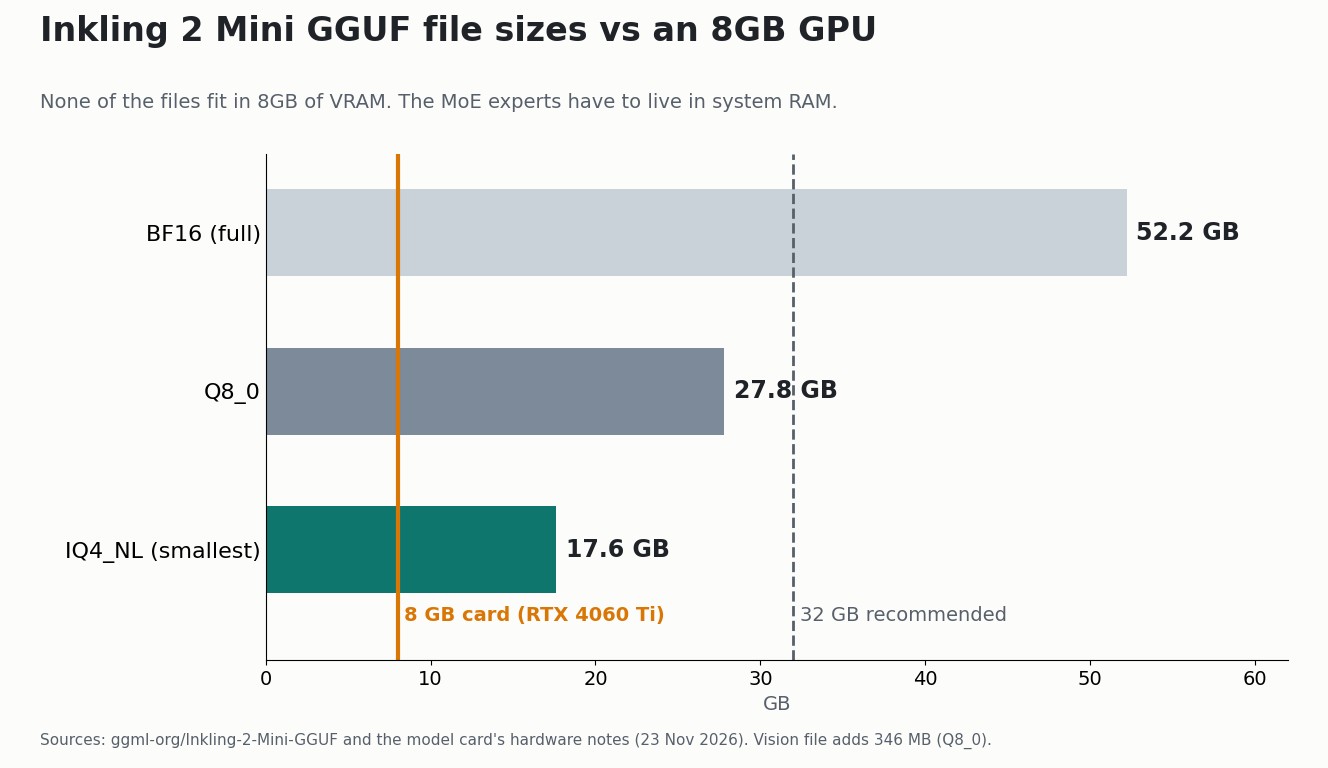
Because it's an MoE model, llama.cpp can keep the expert weights in system RAM and put the rest on the GPU. This should suit MoE models better than dense ones, because only a few experts are read for each token. My RTX 4060 Ti 8GB has 64GB of RAM (see my 64GB RAM + 8GB GPU build), and I've already run a dense 27B model split between GPU and CPU at about 8.5 tokens per second. With 32GB of RAM, the 17.6 GB IQ4_NL file should fit too, but tightly.
The official one-line start, from the ggml-org GGUF page, using the smallest file:
llama serve -hf ggml-org/Inkling-2-Mini-GGUF:IQ4_NLTwo warnings before you try it. First, looped-model support is new, so you may need the latest llama.cpp build rather than the one from my llama.cpp v1 benchmark. Second, with three passes through the middle layers and the experts in system RAM, don't expect the speed of a normal 3B model. Real tokens per second on an 8GB card is the number to watch, and I haven't measured it yet.
Is Inkling 2 Mini worth trying?
Yes, if you want a private coding or document helper and can live with English-only output. For a model you can run at home under Apache 2.0, the coding, document and screen scores are very strong. The honest limits list is a good sign too.
If you mainly work in Chinese, or want a model that reliably follows a long list of project rules, the card itself says to look at bigger models. For other open models I've covered recently, see NVIDIA Nemotron for Science (whose Nemotron 3.5 Super VL is also on Inkling's comparison table) and Tencent Hy4 flash. For the cloud side, my GPT-6.2 Astra and Sol post covers this week's big closed model.
Sources
- Thinking Machines Lab, Inkling 2 Mini model card on Hugging Face (thinkingmachines/Inkling-2-Mini), released 20 Nov 2026, read 23 Nov 2026
- Hugging Face blog post "Inkling 2 Mini" (huggingface.co/blog/inkling2mini)
- ggml-org/Inkling-2-Mini-GGUF on Hugging Face, for file sizes and commands
- All benchmark scores are vendor-reported, not independent. Charts redrawn by me. Research and drafting were AI-assisted, and I checked the numbers against the model card.