
RBA Raises the Cash Rate to 4.60% — Australia’s Fourth Rise of 2026
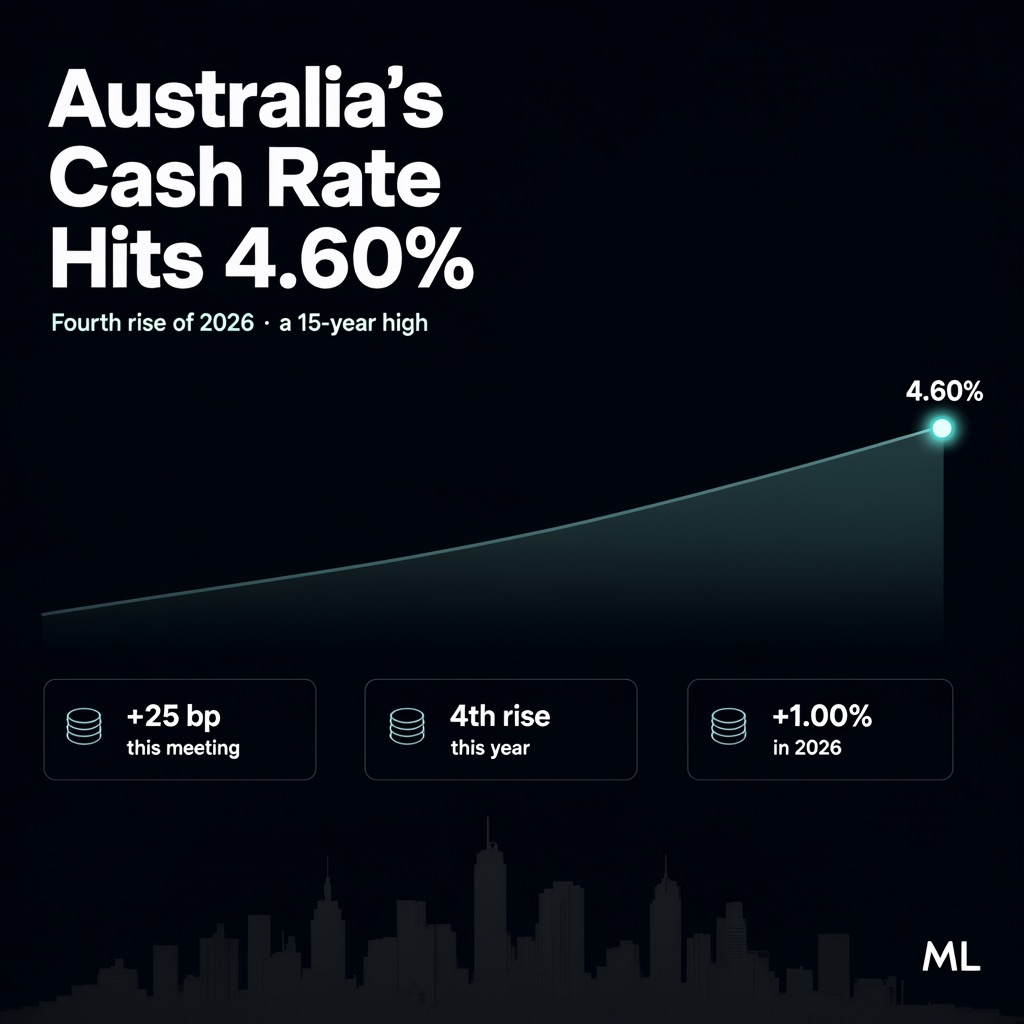
Illustration · image created for this article
On 29 September 2026 the Reserve Bank of Australia raised the cash rate by 25 basis points to 4.60 per cent, effective the following day. It is the fourth increase of the year: since January the rate has climbed one full percentage point, from 3.60 per cent to its highest level since November 2011.
What that costs depends on the loan. On the average new owner-occupier mortgage of $735,000, the increases already passed through are worth about $333 more a month — and about $472 a month if all four reach borrowers in full.
Below: the three claims being made about this decision, checked; what the increase actually costs; and the harder question behind it — whether the government should cut spending to slow inflation, and what that would do to the families the Reserve Bank is already squeezing.
The decision, in short
- Announced
- 29 September 2026 (effective 30 September)
- Move
- +25 basis points
- Cash rate
- 4.35% → 4.60%
- Vote
- Unanimous
- Rises in 2026
- Four — February, March, May, September
- Cumulative
- +1.00 percentage point (3.60% → 4.60%)
- Highest since
- November 2011
- Inflation
- 4.0% headline, 3.6% trimmed mean (August 2026)
- Next decisions
- 3 November and 8 December 2026
What the 4.60% cash rate means for household budgets
Mortgage repayments on a typical loan
The rate people actually pay matters more than the headline. The Reserve Bank's own measure of rates paid by owner-occupiers on principal-and-interest loans moved from 5.48% in December 2025 to 6.19% in July 2026 — most, but not all, of the first three increases had reached borrowers by then. Macquarie has since passed September's rise on in full; at the time of writing the big four had not yet confirmed.
That gives two honest numbers, and they answer different questions:
| Basis | Average loan ($735,000) | Per year |
|---|---|---|
| Observed so far (5.48% → 6.19%) | +$333 / month | +$3,994 |
| If all four pass through in full (5.50% → 6.50%) | +$472 / month | +$5,670 |
| This meeting alone | +$120 / month | +$1,440 |
Standard 30-year principal-and-interest amortisation. Loan size: ABS Lending Indicators, March quarter 2026 — the average new owner-occupier loan, which is larger than the typical outstanding balance.
The path below shows how a single 25 basis point step turns into the full year’s increase. Each step is worth roughly $120 a month; four of them are worth roughly $472.
| Rate paid | When | Monthly on $735,000 | Change |
|---|---|---|---|
| 5.50% | Start of 2026 | $4,173 | — |
| 5.75% | 1st rise (February) | $4,289 | +$116 |
| 6.00% | 2nd rise (March) | $4,407 | +$118 |
| 6.25% | 3rd rise (May) | $4,526 | +$119 |
| 6.50% | 4th rise (September) | $4,646 | +$120 |
Scenario: assumes every rise is passed on in full and the rate holds. Figures are rounded, so the yearly totals are approximate.
Renters, savers and everyone else
- Renters are not insulated. Higher rates discourage new supply and investors pass costs on. Rental affordability has effectively collapsed: Anglicare found just one listing in about 49,000 affordable on JobSeeker, and 0.5% affordable for a full-time minimum-wage worker.
- Savers benefit from higher deposit rates — but the household saving ratio has been above 6% for three quarters, which suggests people are rebuilding buffers rather than spending.
- Borrowing power shrinks. Canstar estimates the four rises have cut the average full-time earner’s borrowing capacity by roughly $47,400, about 9% since the start of the year.
- The squeeze is not evenly shared. The average new loan overstates what most households owe, and borrowers with fewer years left on their loan are hit less than the table above suggests.
The three claims, checked
Three things are being said about this decision. All three survive checking — but each needs careful wording, and one is commonly rounded.
- “It’s the fourth rise” — correct. The RBA’s own record shows four increases in 2026: 4 February, 18 March, 6 May and 30 September. The Board’s statement refers to “the three increases in the cash rate target since the beginning of the year” — those are the three that came before today’s, which is the fourth.
- “One per cent higher this year” — right number, imprecise unit. Four rises of 25 basis points are exactly 100 basis points: the rate went from 3.60% to 4.60%. That is one percentage point. Saying “1% higher” can be misread as repayments going up 1%; in fact the rate level is about 28% higher in relative terms.
- “A 15-year high” — defensible, but rounded. Precisely, 4.60% is the highest since November 2011, when the rate was 4.75% and was cut to 4.50% effective 2 November. That is 14 years and 11 months — so “highest since November 2011” is the exact claim, and “15-year high” is how most of the press has put it.
Why the RBA raised rates a fourth time
The Board’s reasoning is unusually direct. Inflation, it said, “remains elevated and some of the upside risks flagged in August are materialising”. Three forces stand out in the statement:
- Energy. “The conflict in the Middle East has broadened and global energy prices are now much higher than had been assumed in the August forecasts.”
- Technology goods. “AI-related demand is driving rapid growth in global prices for technology-related goods.”
- Domestic capacity. “There remains pressure on domestic capacity… firms are experiencing cost pressures and are either increasing the prices of their goods and services or looking to do so.”
But there is a timing point worth noticing. The Board decided on 29 September; the August inflation figures were released on 30 September — the day after. The Board did not see them. Those numbers, when they landed, showed headline inflation at 4.0% and the trimmed mean steady at 3.6%: both above the 2 to 3 per cent target band.
Inflation is still above the 2–3% target
What is striking about the August data is the split. Headline inflation jumped from 3.5% to 4.0% in a month, but underlying inflation barely moved, sitting at 3.6%. That matters, because it suggests the jump is concentrated rather than general — and much of it traces to policy and supply rather than to demand:
- Automotive fuel +13.5% — which the ABS attributes to “higher world oil prices and the unwinding of the remainder of the federal government’s fuel excise relief measures”.
- Electricity +13.2%, with utilities inflation running at 19.9% as energy rebates expired.
- New dwellings +5.4%, as builders pass on higher labour and materials costs.
Keep that in view for the next section: some of the inflation the rate rise is fighting was measured higher because government relief was withdrawn. That is not an argument against anything — but it complicates the simple story.
The government spending and inflation debate
Here is the question behind the rate rise: if inflation is the problem, shouldn’t the government cut spending to help fix it — and wouldn’t that make things harder for families already paying more?
It is a genuinely contested question, and the honest answer is not a slogan. First, a boundary: the Reserve Bank’s September statement contains no commentary on government spending at all. Any claim about what the Board thinks of fiscal policy has to come from elsewhere — and when the Governor did speak about it, in May 2026, she was careful.
“When inflation is already too high and the economy facing capacity pressures it doesn’t take much additional spending to make the job of returning inflation to target more challenging. This means spending will need to grow more slowly for a time…”
Michele Bullock, RBA Governor — media conference, 5 May 2026
“…in order to close that gap we have to have demand growing by less than 2 per cent. And both private sector and public sector have to contribute to that.”
Michele Bullock — same conference
“Australians are poorer because of this shock to oil prices and energy prices… We are poorer and there is no way out of that.”
Michele Bullock — on the energy shock
The Treasurer’s line, and the rebuke
On decision day, Treasurer Jim Chalmers pointed to the war in the Middle East as a significant driver of the rate rise — a framing that matches part of what the Board itself cited, because the conflict and energy prices are one of the three forces named in the statement. With the Reserve Bank preparing to lift the cash rate to its highest level in almost 15 years, the argument about who is responsible was already running in public.
“The Treasurer is gaslighting Australians, according to one of the country’s leading economists.”
NewsRadio — Sarah Morice with Professor Richard Holden, University of New South Wales · 29 September 2026
That charge is a political claim by a named economist, not an established finding — and it belongs next to the rest of the evidence rather than replacing it. On the facts: the war and energy prices really are in the Board’s statement; that statement contains no commentary on government spending at all; and the Board also insists that both private and public demand must contribute to slower growth. Blaming the war alone answers only part of the question the RBA is acting on — and so does blaming spending alone.
What the spending hawks argue
- The Commonwealth Bank judged the 2026–27 Budget “neutral-to-mildly expansionary” and said it “does little to help in the fight against inflation”, adding that greater restraint “would have… created more headroom for the RBA… the risk sits with further tightening by the RBA”.
- The Opposition points to spending at around 26.9% of GDP — by its measure the highest share of the economy since 1986–87 outside the pandemic — and argues a 0.8%-of-GDP deficit is expansionary.
- The OECD’s 2026 survey of Australia calls for gradual fiscal adjustment “to avoid boosting demand once the output gap is closed”. Note what that is: an argument for consolidation, timed — not an argument against cutting at all.
What the data can and cannot show
- The figures on each side are measuring different things. The government cites real spending growth of about 2% and points out that four in every five dollars of demand growth is private; new public final demand grew 2.2% in 2025–26, its slowest in 11 years. The Opposition’s 4.3% is a single year, and “share of GDP” moves with the denominator as well as with spending. Neither is simply wrong — they are not the same measurement.
- Some of the inflation is not a spending problem. Fuel, electricity and building-materials costs are supply-side. Cutting government spending does not lower the world oil price.
- But fiscal policy is already inside the numbers, in both directions. Relief mechanically lowers measured inflation while it runs — the fuel excise halving cut year-ended inflation by around 0.5 percentage points — while adding to demand. Letting relief expire raises measured inflation. There is no clean lever marked “cut spending, inflation falls”.
- And cuts would have to be large to matter. As economist Alison Booth and colleagues have put it, “cuts would need to be large, targeting areas where spending is growing the fastest, such as health, the NDIS, defence and natural disasters. Trimming at the margins — for example, cutting public service budgets — would not help much.”
So — should the government cut spending?
The strongest case for restraint is not about oil prices at all. It is about second-round effects: holding demand down is how a price shock stops becoming permanent. The Reserve Bank is plainly in that camp — it says spending “will need to grow more slowly for a time”, and that both private and public demand must contribute.
But three things complicate it. First, the counterfactual cuts the other way. If demand is not restrained, the Board’s own words — it will act “including increasing the cash rate target further if needed” — point to more rate rises. By this article’s own arithmetic, that is worse for the same households. Second, some pressure is cost-side, and rate rises do not fix that either. Third, the evidence is genuinely thin: no Australian study quantifies how much inflation a spending cut would actually remove, or how long it would take. That gap cuts both ways — it undercuts confident claims on either side.
Where that leaves the family asking the question: monetary and fiscal tightening at the same time subtracts demand twice, and the Reserve Bank itself acknowledges households with mortgages are “hurting immensely”. The defensible position is not austerity timed to collide with the mortgage shock, nor open-handed relief that adds to demand — it is targeted support for the people who need it, alongside a credible medium-term plan to bring the deficit down. The blunt version of either instrument lands hardest on people who did not cause the shock.
Questions, answered
Why did the RBA raise rates again?
Because inflation stopped falling. The Board said the upside risks it had flagged in August were materialising, global energy prices were well above its forecasts, and there was still pressure on domestic capacity. Underlying inflation sat at 3.6% — above the 2 to 3% target band.
Will my repayments go up?
If you are on a variable rate, most likely yes. This rise alone is worth about $120 a month on a $735,000 loan over 30 years, and the four rises together about $333 a month already — $472 once all lenders pass them on. Fixed-rate borrowers are unaffected until their fixed term ends.
How much does a 0.25 point rise add to a mortgage?
On a $735,000 principal-and-interest loan over 30 years, 25 basis points is about $120 a month, or roughly $1,440 a year. On a $614,000 first home buyer loan it is about $100 a month.
Is government spending keeping inflation high?
It is contested. The largest drivers in the August 2026 data were fuel, electricity and housing costs, which spending cuts do not directly lower. But the Reserve Bank says spending needs to grow more slowly and that both private and public demand must contribute. Economists differ sharply, and no Australian study quantifies the effect of spending cuts on inflation.
Will the RBA raise rates again in 2026?
The Board kept its options open, saying it would act “including increasing the cash rate target further if needed”. Two decisions remain this year, on 3 November and 8 December. Most major bank economists expect 4.60% to be the peak, though ANZ has forecast a further rise to 4.85% in November.
What would change the picture
- Underlying inflation turning down again. The trimmed mean is the number to watch — if it falls back toward 3%, the argument for another rise weakens sharply.
- Energy prices falling. Much of the headline jump is oil and electricity. A sustained reversal would take pressure off both the CPI and household budgets.
- Unemployment rising well above 4.6%. That would shift the debate from “will they raise again?” to “when will they cut?” — which is a harder problem, not a better one.
- A credible fiscal consolidation path that does not land in the next few quarters would give the Board room, without squeezing households twice at once.
Sources
- Reserve Bank of Australia — Statement by the Monetary Policy Board: Monetary Policy Decision, 2026-27
- Reserve Bank of Australia — Cash Rate Target (historical series)
- Reserve Bank of Australia — 2026 Monetary Policy Board Meeting Dates
- Reserve Bank of Australia — Governor’s Media Conference
- Reserve Bank of Australia — Statement on Monetary Policy
- Australian Bureau of Statistics — Consumer Price Index, Australia, August 2026
- Australian Bureau of Statistics — Lending Indicators
- Australian Bureau of Statistics — Lenders’ Interest Rates (Table F6)
- Anglicare Australia — Rental Affordability Snapshot 2026
- Commonwealth Bank — 2026–27 Federal Budget analysis
- NewsRadio — Sarah Morice interviews Professor Richard Holden
Not financial advice. This article is general commentary on publicly released data from the Reserve Bank of Australia, the Australian Bureau of Statistics and published economic research, written on 30 September 2026. It does not take your objectives, financial situation or needs into account. Consider whether the information suits your circumstances and, where relevant, speak to a licensed financial adviser. Repayment figures are modelled scenarios with stated assumptions, not quotes from any lender. The RBA’s next decisions are scheduled for 3 November and 8 December 2026 and this page will not update automatically.
Found this useful?
Buy me a coffee ☕
Everything here is free and ad-free. A coffee or a AU$1/month membership keeps new articles, games and tools coming.
Also in the shop: VoidFill · The Architect’s Monologue · Brisbane photo prints